
I know that many among you, Lovely Readers, hold issues of sustainability, nature and respect for life close to your hearts. As I often explore the intersection of QiGong, science, and ecological spirituality, I cannot help but wonder:
How can we heal the Earth when we, ourselves, are broken and suffering? How can we ease human suffering, the plethora of “diseases of civilisation” as well as our deeply broken mental health, when Nature is under constant assault and the jungles of Amazon are burning?
Those difficult yet urgent questions are what a group of world-class thinkers attempted to tackle at a conference hosted by the great Brazilian astrophysicist, Marcelo Gleiser, in Italy. Marcelo’s goal is to forge a new, ecological spirituality, rooted deeply in science rather than in blind belief.
As someone who loves both science and the subtle work with energy, I was beyond joyful to have the privilege to learn from some of the world’s best scientists and philosophers – as well as teach them QiGong!
I want to share some of the insights with you all, because I know that if you are on my list, or a part of my Qi Tribe, you deeply care.
Marcelo is the author of, among his many other oeuvre, “The Dawn of a Mindful Universe”, winner of the Templeton prize for combining sciences and humanities in an effort to create a modern, ecologically-focused spirituality, as well as co-author of the “Blindspot”. The topic of “Blindspot” is very close to my heart. It argues that the existing paradigm of science has failed to take into account something most crucial to us all: the lived aspects of human experience. And as such, it has produced science which is de-humanised and de-sacralised at the same time, stripped of awe and meaning, and driving the biosphere and consequently, our own species, into extinction.
This is all of great relevance to someone who, like myself, aims to build bridges between the East and the West. The difficulty of reflecting the essence of Chinese Medicine – both acupuncture and QiGong – in the Western research framework and epistemological model, is something I struggle with daily. The experiential learning required by both does not fit into Western (Cartesian) epistemological model and I sweat buckets to explain this when teaching students at the International College of Oriental Medicine.
Back to the conference.
Mr Gleiser has gathered a circle of prominent thinkers in the (rainy) Tuscany: each a world-class expert in their own field.
This, for me, was like the best summer camp! I just loved being there! I am forever a learning nerd and proud of it! Every morning my brain was steaming with ideas and new knowledge… and then, we had Italian coffee every break – while continuing discussions one on one. What is not to love?
Teaching QiGong to world-class scientists
It was also quite an experience to teach QiGong – and explain the science of QiGong – to this lot of geniuses. Evan Thompson has trained himself probably since I was in the crib, but some of the participants were new to the practice. And here is a bit of disclosure… Because of how high-profile those people are, I was very secretly, very deep down petrified. I know I am a good teacher, but I am also someone who always aims at excellence. So… I was secretly anxious enough that I even had a dream in which I kept pondering and changing the movements I teach on the go! 😀
Luckily, I have plenty of experience in putting such feelings aside and interpreting them from a wider perspective. I have done it many times in my life since the beginnings of my QiGong practice, and now coach others how to develop breathing and other techniques which allow us to dissolve the stress and anxiety and just roll with it. So, I breathed deep and low and aligned my body with my heart’s true purpose: which is not to show off, but to share and to empower.
Did it go well? You bet it did!
Did I still feel I could have done better? Yes, I did! I always see potential for growth, but I also learnt to see it as a good thing. It is logical for the 100th QiGong workshop to be better than the 10th one, right? And the 1000th one even better. This is how we learn. If we were not to improve, it would mean we do not learn.
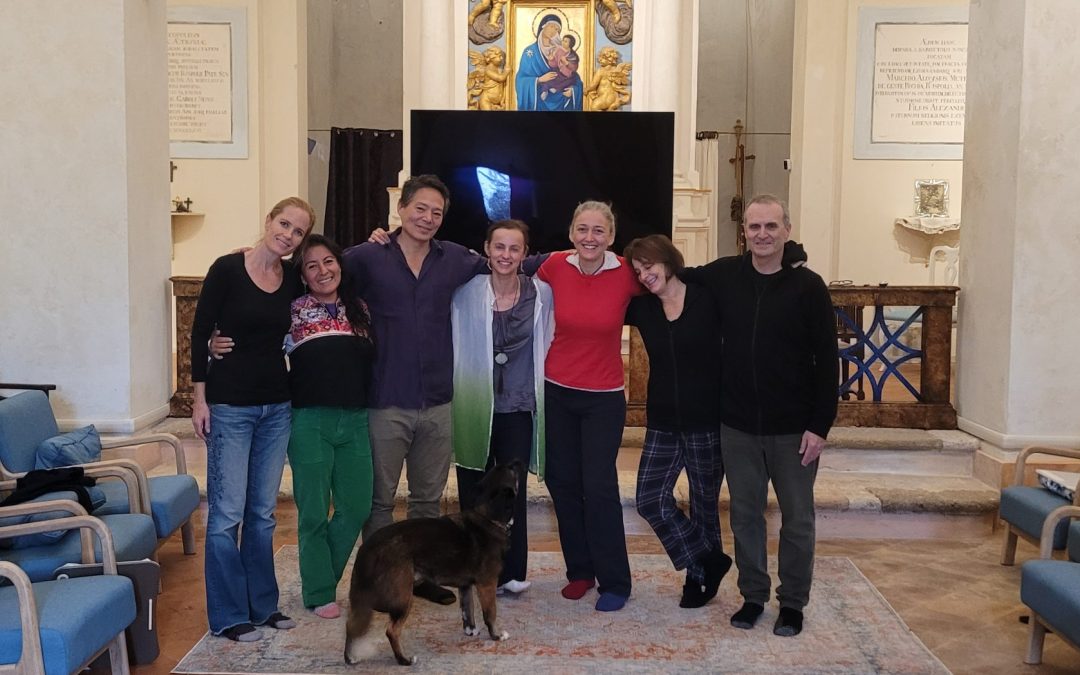
But no one else knows about my slight criticism of myself – well, apart from you now, dear Readers! 😉 The scientists in fact loved my session so much they asked me to do another one, if I would be so kind. I was, and we had even more fun. Check out the picture from day two up by the title (Marcelo Gleiser was not there, as he was on a school run duty, but he told me in person how powerfully he felt after the first session).
One the title photo from the right:
Evan Thompson, one of the precursons of embodied cognition, Beck Todd, a neuroscientist studying emotion, attention and synchrony between people, Monica Gagliano, a trailblazer in plant intelligence studies, (me), Peter Ulric Tse, a neuroscientist hell-bent on proving we have free will, Yuria Celidwen, a Maya spiritual leader and indigenous rights activist, Kari Gleiser, a trauma therapist and with her husband, Marcelo Gleiser, our host. And the dog’s name is Felix!
Insights: don’t give up! The need for an ecological spirituality and connection
Here are some wonderful things I learnt, as well as suggestions for further reading for those of you so inclined.
- The brain can reorganise itself, and our thoughts play a big role in it! It is not just deterministic. You may have heard of the “activation potential” of one neuron triggering off the firing of another. But this is just a small part of the story: neurons impose their own conditions on how to interpret the signals that they receive, and moreover, those conditions can dynamically change!
- Plants can learn! Researchers have now applied Pavlov’s conditioned response experiments to plants! The original experiments (involving a dog and a bell: a dog started to associate the sound of a bell with food, and would salivate when hearing the bell. To adapt this to the world of plants, blue light was used as “food” and a gentle fan as the “bell”.
- The Enlightenment has created a world based on reductionist science, where objects, organisms and ecosystems can be divided, and each part studied separately;
- This does not work, however, for living organisms, and neither does it work for the biosphere
- That the narrowly defined intelligence, which is essentially seen as logical problem-solving with a narrow focus, brings about the problem of losing the bigger picture
- That wisdom necessitates the awareness of a wider perspective. How to gain a wider perspective? Through various traditional practices as well as connections and interactions – each connection we make opens our world a little bit more.
- We need to recognise, as humanity, the deep interconnectedness of all living things…
- As well as all the parts within ourselves (lack of divide between the mind and the body).
- That interconnectedness has been practiced from ancient times by indigenous peoples, to whose knowledge the world is waking up now, yet a lot of this “awakening” is done in a way which does not respect those people’s cultural heritage…. Instead, culturally appropriating it into Western ways of thinking.
- One such example being ayahuasca – which has become a tool rather than a dialogue;
- Fostering interconnectedness is a job for a lifetime, and requires dialogue between people;
- And (with my own contribution to the discussion): that healing is crucial for this dialogue, as people full of fear, pain, and feelings of inferiority cannot be truly open or truly reach out.
Further reading on science and ecological spirituality
The topic of ecological spirituality, and how science leads us to a new understanding of the body-mind-biosphere interaction (or unity), emerges with tidal power from all of these works. Apart from Yuria’s paper on the Ethics of using indigenous medical plants, I am providing only the titles of books. All of the authors have also written many scientific papers, for those of you out there who love research, which can be easily found through Pubmed or their personal sites.
I have not read all of them, but am in the process of doing so!
- The Embodied Mind: Cognitive Science and Human Experience. By: Francisco Varela, Evan Thompson and Eleanor Rosch. The MIT Press, 1991; 2nd ed. 2017.
- Waking, Dreaming, Being: Self and Consciousness in Neuroscience, Meditation, and Philosophy. By: Evan Thompson. Columbia University Press, 2014.
- The Blind Spot: Why Science Cannot Ignore Human Experience. By: Marcelo Gleiser, Adam Frank, Evan Thompson. The MIT Press, 2024.
- The Dawn of a Mindful Universe: A Manifesto for Humanity’s Future. By: Marcelo Gleiser. Harper One, 2023.
- Mind in Life: Biology, Phenomenology, and the Sciences of Mind. By: Evan Thompson. Harvard University Press, 2010.
- Flourishing Kin: Indigenous Wisdom for Collective Well-Being. By: Yuria Celidwen. Sounds True, 2024.
- Thus Spoke the Plant: A Remarkable Journey of Groundbreaking Scientific Discoveries and Personal Encounters with Plants. By: Monica Gagliano. North Atlantic Books, 2018.
- The Neural Basis of Free Will: Criterial Causation. By: Peter U. Tse. The MIT Press, 2013.
- A Neurophilosophy of Libertarian Free Will. Peter U. Tse. Oxford University Press, 2024.
- Ethical principles of traditional Indigenous medicine to guide western psychedelic research and practice. By: Yuria Celidwen et al. The Lancet, 2023. https://doi.org/10.1016/j.lana.2022.100410
- Why some conservatives are blind to climate change: A Conversation article on new study by Jennifer Whitman, Jiaying Zhao, and Rebecca Todd http://theconversation.com/why-some-conservatives-are-blind-to-climate-change-91549
If you get your hands on any of these books and want to discuss them – please get in touch! You will find many of them referenced in the book I am now writing on the neuroscientific impact of QiGong, and a discussion, whether in person or over the phone when walking dogs, is always welcome 😊
Photo by Michael Sacca.
What a delightful read! Thank you Iga so much!
These are absolutely fascinating subjects that I’m trying to explore by myself throughout different sources. The Garden Club, that I attend regularly seems to be more and more breathtaking with themes that are brought by interesting speakers! Meeting people like you or belonging to my Catholic Community, where I learn about the connection of each beautiful layer of our existence as humans and our amazing planet Earth.
I can’t wait to read your book, Iga!!🙂 Thank you so much for sharing your experience.
Lovely Anna, thank you so much for your comment and your enthusiasm – it is contagious in its own right 🙂 Exploring something through different sources is the best, it really helps one to widen one’s perspective. It is wonderful that you do that. We had just this interdisciplinary vibe in Tuscany. And moreover, something I did not speak about in the article, but believe will resonate with you deeply: I think we all felt there is something deeply sacred about life. About the miracle of our existence as well as the miracle of any and every existence around us: the plant, the tiniest insect, the amazing creatures with individual and collective intelligence. One can feel it as long as one pays attention, regardless of man-made lables such as Christian, Buddhist or agnostic etc. The truth of the world and its sacredness is there, it is experiential. Like that time when Mira felt the warmth of a plant behind her when doing QiGong 🙂
Thank you so much for this article. It touches on something I feel in my bones: the interconnectedness of everything is key. I speak as someone who loves to have her hands in the soil, who finds solace in nature and poetry but is also fascinated by science and research. I’m no expert but I love to learn.
Getting people together to discuss a way forward – something to cheer on and celebrate!
Hello Katy! Thank you for your thoughtful comment! I’m so glad the article resonated with you, it is exactly people like yourself I hope to reach, so this gives me motivation to write more, too! Nature, poetry and research should not be seen as mutually exlusive, I find it a little sad they inhabit such completely different niches of our human world. I think you might really like some of the reading from the authors I suggested above, if you have the time. You are welcome to send me a private email if you’d like to ask about a partcilar book, they vary quite a bit in how science-heavy versus readable they are. 🙂 Meanwhile, happy Autumn to you.
Hello Iga!
Thanks for this incredible insight into a remarkable experience. Well done!
How can we heal the world when we need healing ourselves is a very important question which I always ask myself in the following form: how can we heal the world while healing ourselves? How can we help our (human) environment when we need help in the first place?
These are crucial questions for a teacher: when young people come to me in need of guidance I feel so responsible and unfit for the purpose! So what I do is to share with them my own way of facing troubles day by day. I invite them not to rush into getting whatever target they aim, stick patiently to their purposes, take one step at a time, be kind to themselves but at the same time work effortlessly to improve. Qi gong has been so helpful with this and still is as I have a loooooooooong way to go but I smile at the idea of not being alone in this self healing journey. Many many hugs
Thank you so much for taking the time to write and for sharing your own reflections! You bring a very important perspective to the discussion: how to guide others, or help others, while healing oneself. It’s a delicate balance, isn’t it? It sounds like you are giving your students the gift of empathy, and modelling for them what patience, resilience and self-compassion looks like. Kudos! 💪
I am also looking forward to seeing where QiGong can take you. There is so much growing evidence about just how plastic our brains, our whole bodies are. And you are very much not alone on this journey! 🤗🤝 There will be people right behind you, in front of you, and alongside you all the way. Check out this powerful thought that Joanna shared on the members’ forum if you haven’t yet: https://www.igasqigongacademy.com/c/campfire-discussion-circle/hi-dear-members-i-d-like-to-share-some-personal-1d6d843b-ebad-4201-9e58-1479eb126ed7
Sending you warm vibes 💗